
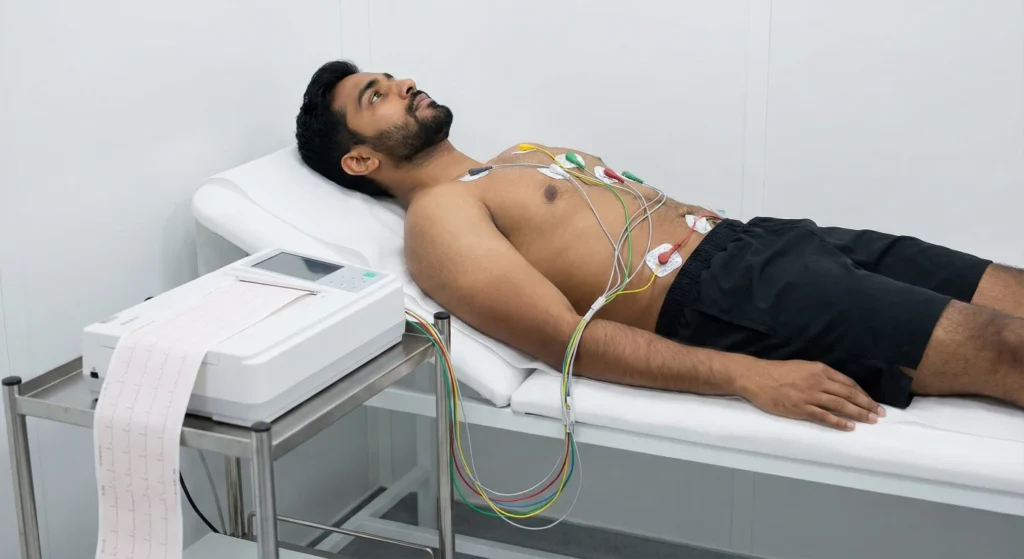
An ECG is one of the fastest tests we run. Electrodes go on, you lie still for a few minutes, and a trace comes out. The harder question people ask at our reception is when they actually need one. Some arrive with a prescription after a bad night of chest discomfort. Others walk in on their own, worried after a relative’s heart attack. Both are sensible reasons to get tested, but they are asking the test to do two different jobs.
What an ECG test records
An electrocardiogram measures the electrical activity that makes your heart beat. The trace shows how fast the heart is beating, whether the rhythm is steady, whether the electrical signal is travelling normally through the muscle, and whether any part of the muscle looks strained or damaged. It can pick up an arrhythmia, a heart block, a current heart attack and sometimes an old one you never knew about.
There is no injection, no radiation and no dye. The whole thing takes about five to ten minutes, which is why it is usually the first heart test a doctor orders rather than the last.
Symptoms that should lead to an ECG soon
Book a test, or ask your doctor about one, if you have:
- Chest pain, pressure or tightness, especially when it comes on during exertion and settles with rest
- A racing, thumping, fluttering or skipping heartbeat
- Breathlessness during ordinary activity, or when lying flat
- Dizziness, near-fainting or an unexplained blackout
- Swelling in the ankles or feet along with tiredness that keeps getting worse
- Discomfort spreading to the jaw, left arm or upper back, particularly with sweating or nausea
In our experience, the traces that turn out to matter often come from people who never used the word pain. They describe gas, heaviness, or a band across the chest. If a symptom keeps returning in the same situation, that pattern is worth recording on paper.
When it is an emergency instead of a booking
An ECG at a diagnostic centre is for planned and referred testing. If chest pain lasts more than ten to fifteen minutes and comes with cold sweat, vomiting, severe breathlessness or a feeling of collapse, do not wait for an appointment slot. Go to the nearest hospital emergency department, or have someone take you. Time matters far more than paperwork in that situation.
Who should get an ECG even without symptoms
Plenty of people test with nothing wrong at all, and that is the point. An ECG is commonly advised if you:
- Are over 40 and having a preventive health check
- Live with diabetes, high blood pressure or high cholesterol
- Have a parent or sibling who had heart disease early
- Smoke, chew tobacco, or have recently stopped
- Are due for surgery and need fitness for anaesthesia
- Are starting gym training, running or any serious fitness programme after years of being sedentary
- Take medicines that can affect heart rhythm, or have a thyroid disorder
- Need a report for employment or an insurance formality
Risk factors rarely arrive alone, which is why our ECG test in Navi Mumbai is often booked in the same visit as a lipid profile and a fasting sugar. One trace plus a few blood parameters gives your doctor a much fuller picture than either on its own.
What a normal ECG does not rule out
This is the part most people are not told. A resting ECG is a snapshot of a few seconds of your heart’s activity, taken while you are calm and lying down.
A blocked artery can exist behind a completely normal resting trace, because the strain only shows up under load. An arrhythmia that appears twice a week will not appear on a ten-minute recording. Structural problems, valve leaks and pumping capacity sit outside what an ECG can see at all.
That is why doctors order follow-on tests: a stress test for exertional symptoms, Holter monitoring when palpitations come and go, a 2D echo for structure and function, and cardiac blood markers when a recent event is suspected. Our lab, led by Dr Nikhil Ningurkar, MD Pathology, handles the pathology side of that workup, and we will tell you plainly when a normal report still needs a specialist opinion.
How to prepare for your ECG
Nothing complicated, but a few things make the trace cleaner:
- Fasting is not required for an ECG. If cholesterol or sugar tests are in the same visit, follow the fasting instructions for those, usually twelve hours with plain water
- Skip body lotion, oil or powder on the chest that morning, since electrodes need direct skin contact
- Men with heavy chest hair may need a small area trimmed
- Wear a separate top rather than a one-piece outfit
- Avoid tea, coffee and smoking in the hour before the test
- Carry your previous ECG and reports, and tell the technician about every medicine you take, including thyroid and blood pressure tablets
Lie still and breathe normally during the recording. Talking, shivering or a tense shoulder can create artefacts that look like abnormalities.
Quick answers
How often should I repeat it? Follow your doctor’s advice. Annually is common with a known risk factor, and only when needed if you are healthy and symptom-free.
Is there a minimum age? No. Younger adults with palpitations, fainting or a strong family history are tested regularly.
Does it hurt? No. The only sensation is the adhesive pads coming off.
Worried about a symptom, or due for a heart check? Sun Diagnostics has been serving Navi Mumbai since 2020, with centres at Seawoods, Vashi and Taloja. Contact us to book your ECG test, or call +91-95183-81830 and our team will help you choose the right combination of tests for your case.
Frequently Asked Question –
1) When should you get an ECG test?
You may need an ECG test if you have symptoms such as chest pain, palpitations, dizziness, fainting or unexplained breathlessness. An ECG may also be recommended if you have heart disease risk factors, are taking medicines that can affect heart rhythm, or need a pre-operative heart assessment. Your doctor can determine whether an ECG is appropriate based on your symptoms and medical history.
2) Can you get an ECG without having any symptoms?
Yes. An ECG may be recommended even when you feel well, particularly when there are cardiovascular risk factors, a strong family history of heart disease, certain medical conditions, or a need for pre-operative assessment. Whether routine ECG screening is appropriate depends on your individual risk and your doctor’s recommendation.
3) Does an ECG test require fasting?
No. Fasting is not required for an ECG test. However, if your ECG is being done alongside blood tests such as a fasting blood glucose or lipid profile, you may need to follow the fasting instructions for those tests.
4) How long does an ECG test take?
A standard resting ECG usually takes only a few minutes to record, although the complete appointment may take longer. Electrodes are placed on the chest and limbs while you lie still, and the electrical activity of the heart is recorded without injections or radiation.
5) Can an ECG detect all heart problems?
No. An ECG records the heart’s electrical activity but cannot detect every type of heart problem. Some conditions may require additional tests, such as an echocardiogram, Holter monitoring, stress testing or cardiac blood tests, depending on the symptoms and clinical situation.